A marketplace can provide technicians. An on-demand labor platform helps you run programs.
See how a governed on-demand labor program differs from a transactional labor marketplace, so you can choose the right model for running field service labor at scale.
Your options for on-demand field service labor
Field Nation
An on-demand labor platform built for technology field service, combining access to skilled local labor with program-level coordination, automation, and performance intelligence.
Transactional labor marketplaces
Primarily designed to connect companies with available independent technicians on a limited basis. Most marketplaces are limited to niche skill sets or only specific geographies. Matching can address some individual labor needs, but companies typically need additional processes to coordinate execution at scale.
Traditional third parties
External organizations that provide field service labor, often adding another operational and margin layer between your organization and the technicians performing the work.
What to consider when choosing an on-demand labor model
Does the model go beyond finding available technicians?
Access matters, but sourcing alone does not create a repeatable field service labor program. Look for infrastructure that helps your team define standards, coordinate work, and evaluate results across locations and work orders.
Can you apply your standards across the program?
A governed program lets your organization define requirements, pricing, workflows, and assignment criteria. The platform should help you apply those standards consistently.
Does performance data improve future decisions?
Individual ratings and profiles help with technician selection. Performance intelligence goes further by turning signals from completed work into information your team can use to improve future assignment and workflow decisions.
Field Nation
PROGRAM STRUCTURE
Field service labor programs: Build repeatable labor programs around your organization’s requirements rather than treating each work order as a separate sourcing event.:
Program standards: Define requirements, pricing, workflows, documentation, and assignment criteria that can be applied across your program.:
Labor network breadth and coverage: Access skilled local labor across markets to support work as demand and coverage needs change.:
Preferred technician groups: Build groups of preferred technicians based on the qualifications and performance signals that matter to your organization.:
Performance Intelligence: Use signals across response, fulfillment, quality, cost, and coverage to inform future program decisions.:
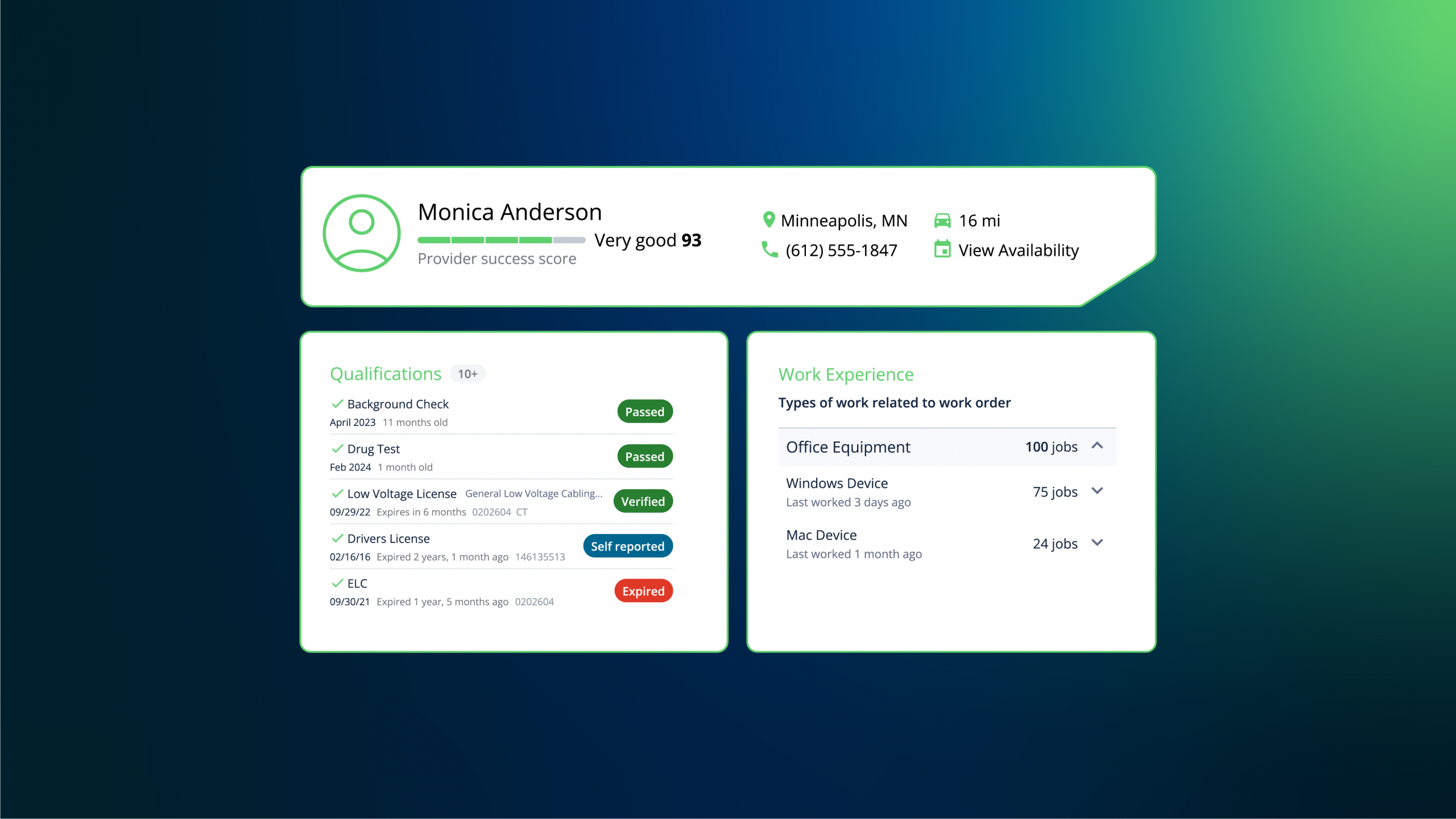
Technician selection: Review skills, location, work history, ratings, certifications, licensing status, and other available information when selecting technicians.:
WORK MANAGEMENT
Automation: Automate repeatable sourcing, matching, dispatch, and work order processes to reduce administrative effort.:
Program-level reporting: Track cost, coverage, fulfillment, and other signals across your program instead of evaluating work orders in isolation.:
Market insights: Use localized pricing and coverage data to inform planning and labor decisions across markets.:
Work order coordination: Coordinate work orders, documentation, billing, and payments through a single platform.:
Dynamic capacity: Scale labor capacity up or down as demand changes without adding fixed overhead for every peak.:
RISK MANAGEMENT
Compliance visibility: Access reporting that supports compliance efforts, including visibility into technician insurance status, screenings, and engagement history.:
Insurance: Support General Liability insurance requirements and provide visibility into technician insurance status.:
Screenings: Access screening information when determining whether technicians meet your organization’s requirements.:
Licensing visibility: Review self-reported licensing information when evaluating technicians for work with specific requirements.:
Transactional labor marketplaces
PROGRAM STRUCTURE
Field service labor programs: Build repeatable labor programs around your organization’s requirements rather than treating each work order as a separate sourcing event.:
Program standards: Define requirements, pricing, workflows, documentation, and assignment criteria that can be applied across your program.:
Labor network breadth and coverage: Access skilled local labor across markets to support work as demand and coverage needs change.:Sometimes
Preferred technician groups: Build groups of preferred technicians based on the qualifications and performance signals that matter to your organization.:Sometimes
Performance Intelligence: Use signals across response, fulfillment, quality, cost, and coverage to inform future program decisions.:
Technician selection: Review skills, location, work history, ratings, certifications, licensing status, and other available information when selecting technicians.:
WORK MANAGEMENT
Automation: Automate repeatable sourcing, matching, dispatch, and work order processes to reduce administrative effort.:Sometimes
Program-level reporting: Track cost, coverage, fulfillment, and other signals across your program instead of evaluating work orders in isolation.:
Market insights: Use localized pricing and coverage data to inform planning and labor decisions across markets.:
Work order coordination: Coordinate work orders, documentation, billing, and payments through a single platform.:Sometimes
Dynamic capacity: Scale labor capacity up or down as demand changes without adding fixed overhead for every peak.:
RISK MANAGEMENT
Compliance visibility: Access reporting that supports compliance efforts, including visibility into technician insurance status, screenings, and engagement history.:Sometimes
Insurance: Support General Liability insurance requirements and provide visibility into technician insurance status.:Sometimes
Screenings: Access screening information when determining whether technicians meet your organization’s requirements.:
Licensing visibility: Review self-reported licensing information when evaluating technicians for work with specific requirements.:Sometimes
Field Nation
Transactional labor marketplaces
PROGRAM STRUCTURE
Field service labor programs: Build repeatable labor programs around your organization’s requirements rather than treating each work order as a separate sourcing event.
Program standards: Define requirements, pricing, workflows, documentation, and assignment criteria that can be applied across your program.
Labor network breadth and coverage: Access skilled local labor across markets to support work as demand and coverage needs change.
Sometimes
Preferred technician groups: Build groups of preferred technicians based on the qualifications and performance signals that matter to your organization.
Sometimes
Performance Intelligence: Use signals across response, fulfillment, quality, cost, and coverage to inform future program decisions.
Technician selection: Review skills, location, work history, ratings, certifications, licensing status, and other available information when selecting technicians.
WORK MANAGEMENT
Automation: Automate repeatable sourcing, matching, dispatch, and work order processes to reduce administrative effort.
Sometimes
Program-level reporting: Track cost, coverage, fulfillment, and other signals across your program instead of evaluating work orders in isolation.
Market insights: Use localized pricing and coverage data to inform planning and labor decisions across markets.
Work order coordination: Coordinate work orders, documentation, billing, and payments through a single platform.
Sometimes
Dynamic capacity: Scale labor capacity up or down as demand changes without adding fixed overhead for every peak.
RISK MANAGEMENT
Compliance visibility: Access reporting that supports compliance efforts, including visibility into technician insurance status, screenings, and engagement history.
Sometimes
Insurance: Support General Liability insurance requirements and provide visibility into technician insurance status.
Sometimes
Screenings: Access screening information when determining whether technicians meet your organization’s requirements.
Licensing visibility: Review self-reported licensing information when evaluating technicians for work with specific requirements.
Sometimes
Build nationwide capacity with skilled local technicians
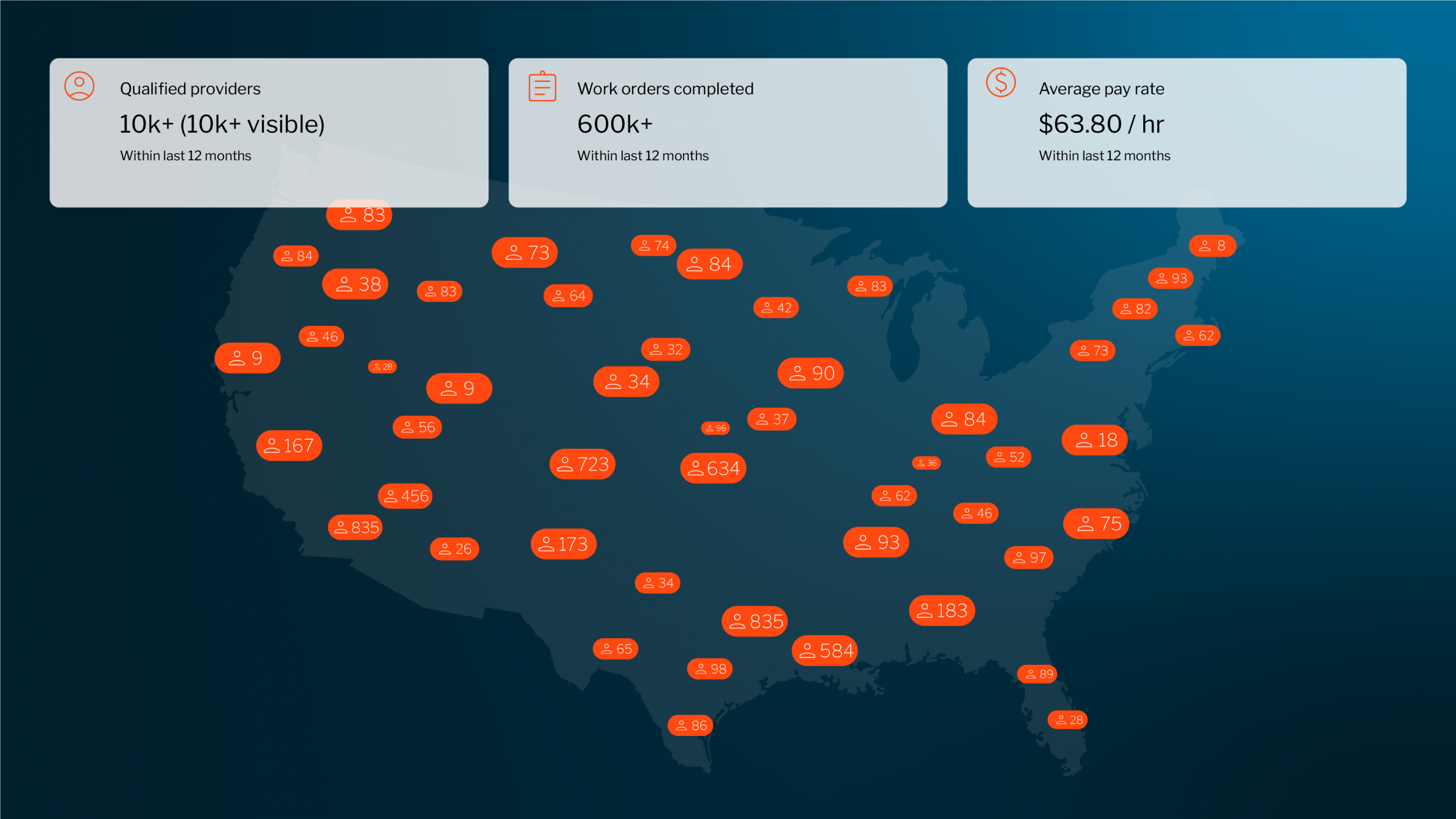
More than 8,000 technicians do work through Field Nation annually, with work orders completed across 36,500+ U.S. zip codes. Use location, skill set, certifications, work history, ratings, and other available information to identify technicians who align with your requirements. Then build Talent Pools of preferred technicians around your program needs.
Active providers
Please note, a single provider may appear in multiple locations or across multiple work types.
Dispatch qualified {category} professionals when and where you need them.
✕
The smarter way to run on-demand field service labor
Plan with localized market insights
Respond to changing opportunities with localized pricing and coverage information.
MarketSmart™ Insights aggregates pricing and coverage data from millions of service jobs across the Field Nation platform, helping sales and operations teams evaluate markets and make more informed decisions.
Make more informed assignment decisions
Matching is more useful when each completed work order informs the next decision.
Review relevant work history, qualifications, ratings, licensing status, and other available signals when selecting technicians. Performance Intelligence adds program-level signals across response, fulfillment, quality, cost, and coverage to help improve assignment decisions over time.
Look beyond access to available technicians. Consider whether the model gives you the infrastructure to define program standards, automate repeatable processes, evaluate technician information, track performance, and support compliance efforts. For organizations operating across markets or at high volume, these capabilities can help turn individual work orders into a repeatable field service labor program.
Transactional labor marketplaces primarily help companies connect with available independent technicians. Field Nation includes that matching capability, but extends beyond it with program-level coordination, automation, and performance intelligence.
Companies use Field Nation to define standards, build Talent Pools of preferred technicians, automate repeatable processes, and use performance signals to inform future decisions. This enables companies to build and operate governed field service labor programs rather than treating each work order as a separate transaction.
Yes. MarketSmart™ Insights gives Premier and Enterprise customers access to localized pricing and coverage data aggregated from millions of service jobs across the Field Nation marketplace. Sales and operations teams can use these insights to evaluate labor rates and coverage by geography, work type, and skill level when planning projects and responding to RFPs.
A transactional marketplace can help you find technicians when one-off needs arise. An on-demand labor platform provides additional infrastructure for operating that labor model at scale.
With Field Nation, companies can establish program requirements, build Talent Pools, automate sourcing and dispatch, coordinate work orders, and track performance across their programs. Performance Intelligence also feeds signals from completed work back into future routing and evaluation decisions, helping teams improve how their programs operate over time.
Field Nation provides information to help your organization make its own technician selection decisions. Depending on the information available, you can review a technician’s relevant work history on the platform, profile, licensing status, qualifications, ratings, private feedback, work order counts, pay rates, and other performance signals.
Your organization determines the requirements for the work and selects technicians based on the factors that matter to your program.
Companies fund work orders through the Field Nation platform. After the work is completed and approved, payment is processed through the platform according to the applicable payment process and terms.
Technicians are independent businesses or professionals using Field Nation and are not employees of Field Nation.
Field Nation offers different options based on how your organization plans to use the platform, including pay-as-you-go and subscription options. Pricing and applicable charges depend on the plan and services your organization selects.
Talk with a Field Nation expert to determine which option fits your field service labor program.
Field Nation offers 24/7/365 live support to help address platform and work order issues when field service work happens outside standard business hours. Support is available by phone, chat, and email.