Read time: 6 minutes


Telecom field service is changing on multiple fronts. While network equipment is becoming more expensive, legacy infrastructure is also being retired, and demand for connectivity continues to evolve. However, fiber expansion, wireless upgrades, and cloud communications are also creating new opportunities for service providers.
Field service leaders are challenged with having the right technical skills and labor coverage to execute projects efficiently, respond to changing demand, and protect margins. Here are six trends shaping telecom field service, and what they mean for the teams responsible for getting the work done.
Network equipment is becoming more expensive and, in some cases, harder to source. That creates challenges for telecom service providers on two fronts: deploying new infrastructure and keeping existing systems operational.
Equipment costs have added another layer of uncertainty to telecom projects in recent months. Gartner projections reported by Network World pointed to potential price increases of more than 20% for enterprise network equipment, driven in part by rising memory costs. Combined with supply constraints and unpredictable lead times, these pressures make it harder for service providers to plan deployments and equipment replacements.
These pressures can affect more than purchasing decisions. When equipment arrives late or replacement costs climb, planned upgrades may be postponed. Organizations may need to keep aging systems operational longer, even as replacement parts become harder to find and some older equipment approaches the end of vendor support. Dell’Oro Group research identifies aging and unsupported equipment as one factor influencing network switch refresh cycles.
Field Nation platform data reflects growing activity in one area of this work. Network equipment troubleshooting work orders increased 21.3% year over year over the latest 12-month period, highlighting growing activity in network maintenance and repair on the platform.
While this growth doesn’t establish a direct connection to rising equipment costs, it reinforces the importance of maintaining and supporting existing network infrastructure.
For service providers, this creates a dual scheduling challenge: responding to ongoing network equipment troubleshooting and repair needs while coordinating new installations around uncertain delivery dates. Flexible technician coverage can help organizations maintain existing infrastructure, complete hardware replacements and network equipment configuration, and mobilize installation teams when materials are ready.
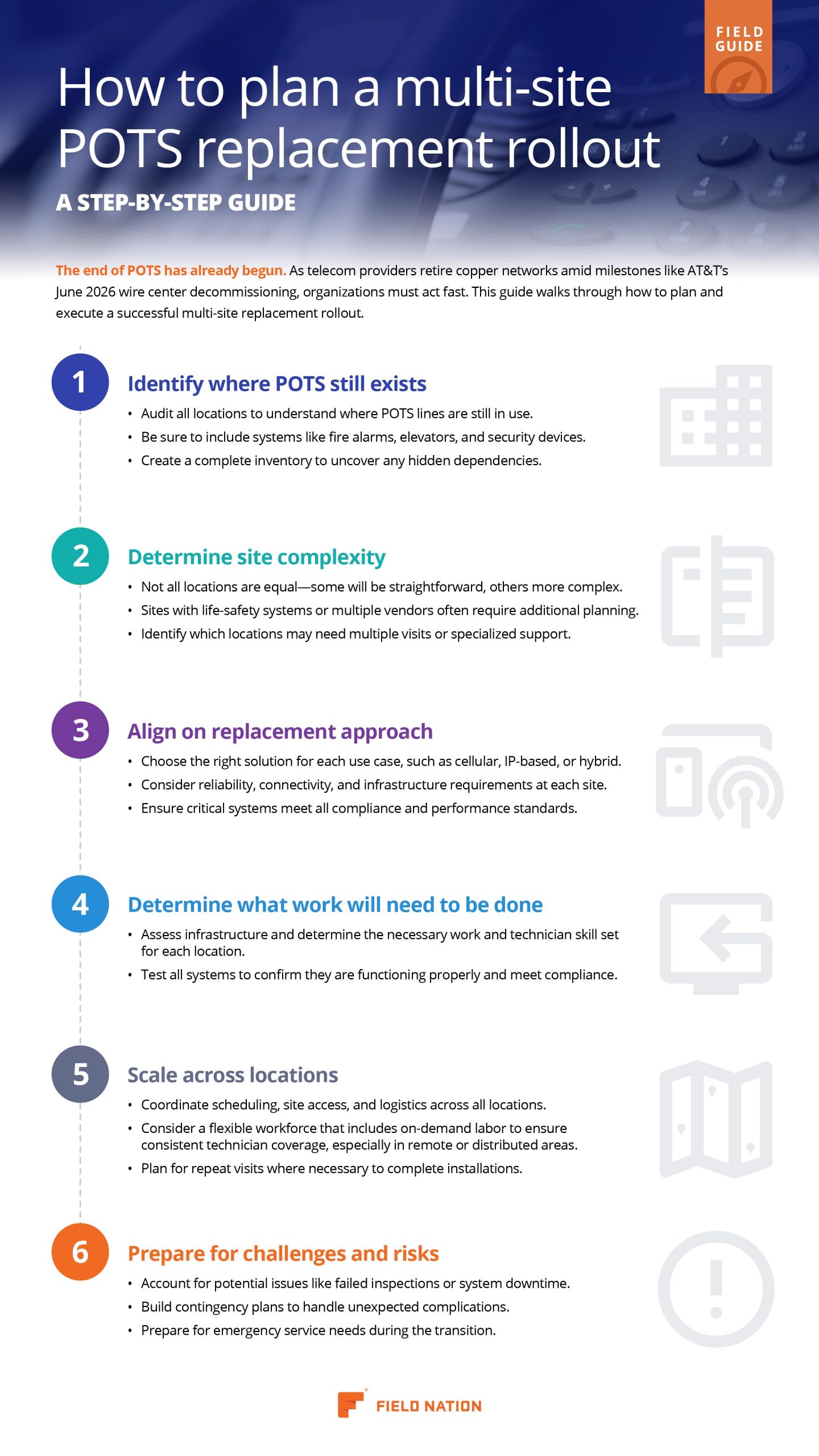
The transition away from traditional copper-based telephone infrastructure continues to reshape telecom field service. As carriers retire legacy Plain Old Telephone Service (POTS) networks, businesses must evaluate and replace connections that may have supported critical systems for decades.
These connections aren’t limited to traditional desk phones. POTS lines can still support fire alarms, elevator emergency communications, security systems, and other equipment that requires careful planning before a service transition.
Carrier retirement schedules are adding urgency. AT&T has announced planned service discontinuations, with certain California transitions beginning on or after June 1, 2027. The California Public Utilities Commission also provides information about the regulatory process surrounding these changes.
Field Nation’s analysis of more than 200,000 POTS and VoIP work orders illustrates how the mix of telecom work is changing. Over a recent 12-month period, POTS work orders declined 38.7% year over year, while VoIP work orders increased 123.6%.
For field service organizations, these transitions require coordinating site surveys, POTS replacement, VoIP-SIP installations, and service cutovers across distributed locations. The challenge is completing migrations within carrier timelines while minimizing disruption to essential services.
Even as some traditional telecom employment categories contract, finding qualified technicians for specialized work remains a challenge.
Fiber installation, splicing, structured cabling, and network troubleshooting can require different skill sets. The technicians available in one market may not be available in another, particularly when major infrastructure projects compete for the same local labor.
This mismatch becomes more difficult when projects involve distributed locations, remote markets, or unpredictable demand. A service provider might have sufficient overall technician capacity but still struggle to cover a particular region or specialized assignment.
Workforce constraints are not unique to telecom. Field Nation’s midyear field service trends research found that 68% of field service organizations report workforce constraints, highlighting a broader challenge across the industry.
For telecom service providers, expanding permanent headcount in every market isn’t always practical. A flexible labor strategy can help organizations supplement their existing teams with qualified local technicians for specialized work, from fiber installation and splicing to structured cabling and network equipment troubleshooting, without maintaining permanent capacity in every location.
Despite pressure on overall capital spending, telecom operators continue investing in targeted network upgrades and fiber expansion.
AT&T has reported reaching more than 37 million fiber locations, with a goal of exceeding 60 million by 2030. Verizon has also outlined plans to surpass 32 million fiber passings by the end of 2026.
These investments illustrate an important distinction: even when overall telecom capital spending faces pressure, certain types of network deployment activity can remain strong.
For field service providers, fiber expansion creates opportunities for network equipment installation, configuration, site activation, and connectivity upgrades. Organizations that can adjust technician coverage as projects ramp up or wind down may be better positioned to pursue these opportunities without taking on unnecessary fixed labor costs.
Wireless modernization is creating new field service opportunities beyond traditional carrier networks. Enterprises are upgrading their wireless infrastructure to support growing connectivity requirements, higher device density, and more demanding applications.
According to IDC’s first-quarter 2026 enterprise WLAN research, Wi-Fi 7 accounted for 44.5% of enterprise dependent access point revenue, compared with 11.8% during the same period in 2025. Overall enterprise wireless LAN revenue increased 15.9% year over year to approximately $2.7 billion.
These upgrades often involve more than replacing wireless access points. Organizations may also need multi-gigabit switching, Power over Ethernet upgrades, structured cabling, and network configuration to support newer wireless capabilities. Dell’Oro Group’s campus networking research provides additional context on the factors driving switching infrastructure upgrades.
Private wireless networks are another area of investment. An industry forecast reported by Computer Weekly projected that CBRS-based LTE and 5G network infrastructure spending could exceed $1.5 billion by the end of 2026.
For service providers, these upgrades create opportunities for wireless installation, access point deployment, structured cabling, and network equipment configuration. Supporting distributed enterprise locations may also require site surveys, switching upgrades, and on-site connectivity testing, making access to qualified local technicians especially important.