
Read time: 5 minutes


As new data centers come online, service companies have more opportunities to win installation, maintenance, and repair work. Jobs range from urgent repairs that need a technician on site within hours to deployments that keep a team busy for months.
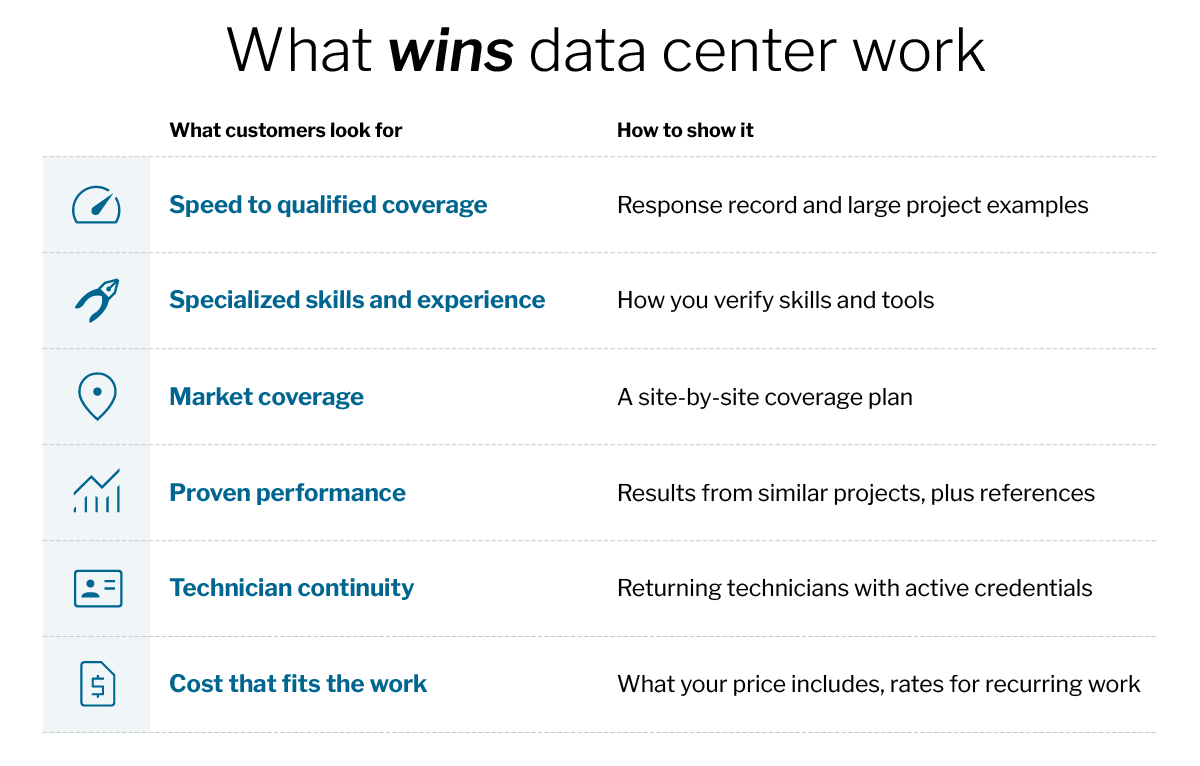
Here are six ways to show data center customers you’re ready for the work.
Data center break/fix contracts often require 24/7 coverage, with a technician on site within a few hours for critical systems. Other requests may call for same-day or next-day service. Onboarding can take weeks, so technicians need the right tools, credentials, and system access before an urgent request arrives. Show customers how you’ve met response commitments and how you arrange backup coverage when a technician is unavailable.
For new builds and large deployments, customers need to know how quickly a partner can assemble a qualified team. The work may require dozens or even hundreds of technicians covering multiple shifts for several months. Share examples from comparable projects: how many technicians you had on site, where they worked, and how quickly they were ready to start.
Customers want technicians with experience relevant to the work, whether that involves a particular operating system, server platform, or type of networking equipment. Specialized experience can help set your company apart. Be ready to show how you confirm each technician has the skills the work requires.
In fiber installation and troubleshooting, for example, technicians need to measure and troubleshoot fiber loss, interpret test results, and inspect and clean connections. Verify they have the right tools, such as a fiber scope, power meter, light source, or OTDR, in advance.
Customers may also want to know how you prepare technicians for unfamiliar work. One approach is to have experienced specialists guide the first few assignments by video call and remain available for troubleshooting afterward. In some cases, specialists can also connect to test equipment remotely. Explain which tasks technicians can handle independently and when a specialist will get involved.
Many data centers sit outside major metros. A service company may deliver strong results in one market but struggle to find the same technical expertise elsewhere. Customers with multiple sites need to know how you’ll meet the requirements at each location.
Sites with less frequent work can be especially challenging. There may not be enough volume for dedicated technicians, yet the customer still expects a fast response. On-demand technicians can help cover those locations, provided there’s a plan to confirm qualifications, availability, and site access within the required timeframe.
Show customers how you’ll cover each of their locations. Point out where you already work with technicians who have relevant experience, how quickly they can reach each site, and how you’ll cover gaps.
Customers want evidence that a service company has delivered consistently on work like theirs. Data center operators may evaluate providers on first-time pass rates, time to productivity, manager satisfaction, and outage response times. Many already track those results in their own systems and use them to set targets in new contracts.
Find out how the customer measures success and defines each metric before presenting your results. A high completion rate may not reveal how much rework was needed or how long jobs took.
If you’ve worked with the customer before, be ready to discuss past results and what you’ve done to address any issues. If you’re new to them, share examples from similar projects, explain how you measure performance, and offer references who can speak to that work.
Data centers need ongoing maintenance, repairs, and upgrades, so technicians familiar with a site are especially valuable. They know the equipment and procedures and already have access, which means faster onboarding. Some RFPs even ask service companies about technician retention and tenure.
Maintaining that continuity also means keeping site and system access current. Customer systems may lock technicians out after 30 or 60 days without a login. Between assignments, work with the customer to keep each technician’s credentials and accounts active so they’re ready for the next job, even if it’s weeks away.
Show customers how you bring proven technicians back to their sites and get new technicians up to speed. Having several qualified people who know a site gives the customer more flexibility in scheduling.
Price matters, but skills, coverage, and performance often matter more when customers choose a data center service partner. A higher rate still needs a clear explanation when another company offers comparable capabilities.
Customers may use should-cost benchmarks to assess rates for similar services in each market, taking technician experience and responsibilities into account. Explain what your price includes, such as specialist support or after-hours availability, and clarify any travel charges so customers can compare proposals on the same basis.
For recurring work, discuss rate cards and expected volume upfront. One-off requests tend to cost customers more. Agreed rates for ongoing work can help customers control costs, while a forecast gives you time to arrange technician coverage.
Data center customers choose partners they can count on at every site. The service companies that earn this business show exactly how their experience fits, how they’ll cover each location, and what they’ll have in place before the first job.
Growing your data center business often means reaching beyond the technicians you already work with, especially for specialized skills or hard-to-cover sites.
See how Field Nation can support your data center labor strategy.