Read time: 11 minutes

The market has changed dramatically since I started Field Nation in 2008. The way companies get field service work done hasn’t changed enough.
The work has changed. The way companies approach field service labor has not kept pace.
Field service now spans more technologies, more locations, and a wider range of work. Demand shifts by market, timing, volume, and skill. Yet companies still rely largely on capacity shaped by the employees and partners they already have in place. When that capacity doesn’t fit the work, the mismatch shows up in travel costs, coordination layers, and slow response times, all of which impact the customer experience.
I saw an earlier version of this problem when I started Field Nation in 2008. I remember meeting people in a coffee shop who were finding labor for large field service projects with spreadsheets, notebooks, and even the Yellow Pages. Finding qualified local technicians and coordinating the work could take hours or days. Coming from a software engineering background, I thought, “We can do much better than this, for both sides.” That idea became the foundation for Field Nation.
Eighteen years later, the challenge is bigger than finding someone for the next job. Companies need a labor strategy that starts with what the work requires, then brings together the right mix of employees, third parties, and on-demand labor to deliver it.
When I started Field Nation, the Internet of Things was just taking shape. Around that time, connected devices outnumbered people for the first time. By 2030, there are expected to be about 55 billion connected devices worldwide, more than six devices for every person on the planet. That’s a lot more technology that will need to be installed, maintained, repaired, and upgraded in the field.
In our early days, much of the work centered on networking, telecom, and point-of-sale systems. Today, field service extends well beyond traditional IT, spanning audio-visual systems, connected cameras, smart buildings, data centers, EV charging infrastructure, and more. Field service teams now need expertise across a broader range of technologies.
The footprint of that work has grown, too. Since 2008, the number of U.S. private-sector business locations has increased by about a third, from 8.8 million to nearly 11.8 million, nearly twice the pace of employment growth. Across retail, restaurants, banking, and healthcare, businesses are opening and closing locations, changing formats, and updating technology across their sites.
Lastly, the commercial footprint is becoming more distributed. Population growth has shifted toward the outer edges of major metros, with some of America’s fastest-growing communities now 30–60+ miles from city centers. Retail is following consumers outward, expanding the geographic technology footprint businesses need to install, maintain, and service.
The economics are getting harder, too. In the 12 months ending August 2026, U.S. gasoline prices rose 27.4%, and airfares rose 23.4%. Producer prices for electronic computers and computer equipment rose 22.5%, while electronic components and accessories rose 27.6%. As travel and equipment become more expensive, sending technicians long distances or adding layers of coordination puts greater pressure on the economics of each job.
Companies have more technology to support across more locations, while the timing and location of work can change quickly. The challenge is matching labor capacity to that demand without carrying fixed capacity everywhere or paying to move technicians to where the work appears.
Finding the right technician has always mattered, but qualified technical talent is increasingly hard to find. The skilled trades currently face a gap of 1.3 million workers. At the same time, companies need technicians in more geographically dispersed markets and across a wider range of work, from one-time installations and recurring repair and maintenance to projects that last weeks or months.
The issue isn’t simply that field service has become more complex. It’s that the shape of demand has changed. Work is more distributed, more commoditized, and less predictable. Yet most labor strategies still depend on capacity that is relatively fixed by geography, skill, or organizational structure.
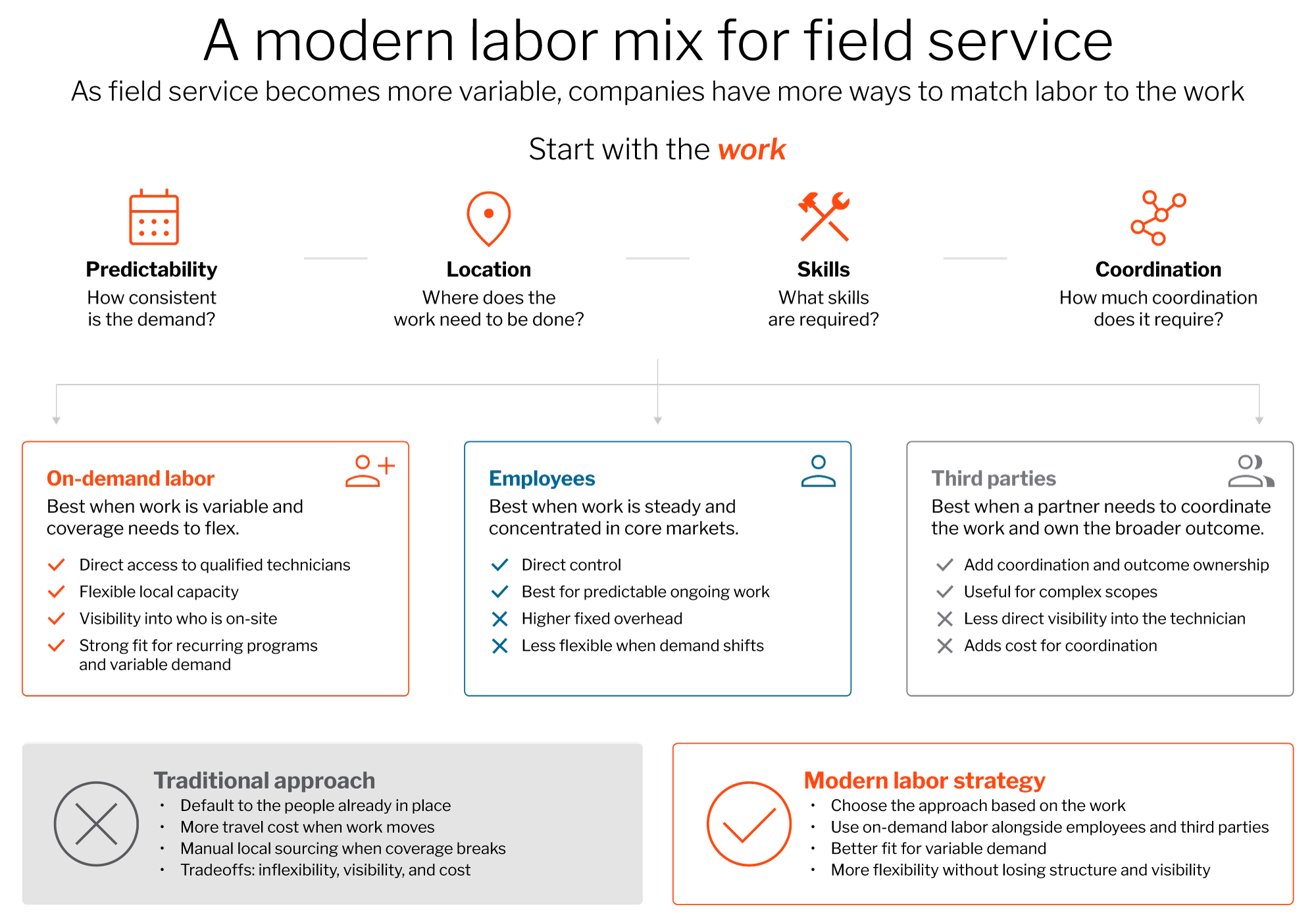
For years, companies have primarily relied on employees and third parties to get field service work done. Employees make sense for steady, predictable work, especially in core markets. Third parties bring value when companies need specialized expertise, project coordination, or ownership of a larger outcome.
The challenge arises when demand exceeds the capacity of employees and partners already in place. Extending coverage then often requires more travel, fixed overhead, or another layer of coordination.
Demand moves. Projects ramp up and down. Customers open locations in markets where existing teams may not have coverage. The skills required can change from one project to the next. Even a well-designed field service organization will have moments when the work extends beyond the people already in place.
Traditionally, companies have had limited options when that happens. They could add employees and take on fixed overhead, send technicians from another market and absorb the travel costs, or ask a third party to find additional labor, often adding another layer of cost and coordination. The same challenge exists for third-party providers themselves: their customers’ demand doesn’t always line up neatly with their existing workforce.
A modern field service labor strategy needs another capability: on-demand labor.
On-demand labor provides a flexible layer of skilled capacity that companies and their partners can use when and where the work requires it. It becomes a third strategic option by extending coverage, leveraging local talent, and adapting to changes in demand.
Many companies have used on-demand labor tactically for individual jobs, short-term gaps, or markets where they needed additional coverage. That flexibility was valuable, but it also raised questions about whether on-demand labor could deliver the scale and reliability that larger programs require.
On-demand labor was also largely transactional in how companies used it. Companies often approached it one job at a time, then started over on the next.
But that didn’t mean the work was transactional for the people doing it. Many independent technicians and service companies were building businesses and reputations of their own, where the quality of every job could influence the next opportunity. What was missing was the infrastructure to connect that individual accountability with the consistency, visibility, and scale companies needed to rely on on-demand labor across a program.
But as the market changed, I could see that our solution wasn’t keeping pace with what companies needed. We needed to make on-demand labor capable of supporting larger, more complex programs with the reliability and governance companies expect. So we invested in building the infrastructure to make that possible.
The first problem was quality. Companies needed to know they could trust the quality of the work, not just for one job, but across an entire program. At the same time, independent technicians needed a way for the quality of their work to build a reputation that followed them from job to job. We rebuilt how quality is measured and how technicians are matched to each company’s requirements. Performance history gives companies a stronger basis for selecting the right technician while giving high-performing technicians the opportunity to build their businesses through the reputation they earn.
The second problem was consistency. Running a few jobs with on-demand labor was one thing. Maintaining the same standards across hundreds or thousands of jobs and markets was much harder. We built the infrastructure for companies to define technician qualifications, service territories, pricing, and work requirements once, then apply them across a program. Standardized workflows and parts logistics help ensure that the technician, equipment, and instructions come together at each site without having to rebuild the process each time.
The third problem was scale. As programs grew, so did the manual effort required to source technicians, coordinate work, and understand program performance. We invested in automation and performance intelligence to change that. Repeatable sourcing and coordination can be automated, performance can be measured across jobs and markets, and a nationwide marketplace provides local capacity as demand shifts. Companies can support more work without adding coordination at the same rate.
The fourth problem was the breadth of the model itself. On-demand labor was largely limited to independent technicians performing traditional IT work, which constrained where and how companies could use it. We expanded both engagement type and work type. We built a solution for longer-term engagements using temporary W-2 employees and expanded the range of technologies we support, including audio-visual systems. Companies can now use on-demand labor across more work types, engagement types, and technical requirements, making it a more versatile part of their field service labor strategy.
These were real limitations of on-demand labor, and we invested to address them. What was once best suited for individual jobs, short-term needs, and a narrower range of work can now support larger, recurring programs – with the quality, consistency, visibility, and scale companies need.
The bigger change is what companies can now build with that infrastructure. They can define who is qualified, what the work should cost, and the standards it must meet, then carry those requirements across an entire program.
Instead of managing quality and execution one job at a time, companies can govern the program and use performance data to improve it. On-demand labor becomes a repeatable part of field service delivery, with the flexibility to respond to variable demand and the structure to support reliable outcomes at scale.
In the past, companies had fewer practical options for getting field service work done. The employees and third-party relationships already in place often shaped how the work was delivered, even when the fit wasn’t ideal, or the people were far from where the work needed to happen.
Today, companies have another lever. On-demand labor gives companies and their partners direct access to skilled, local labor exactly when and where the work requires it. Instead of building permanent capacity for peak demand or sending technicians long distances to reach the customer, they can add local talent as demand shifts across markets.
That capability is increasingly critical to delivering field service profitably. Demand is more volatile than ever. Customer locations are even more geographically dispersed. The volume, timing, location, and required skills can vary from one program to the next. Building enough fixed capacity to cover every possibility is expensive, but failing to have capacity where the customer needs it puts growth and service levels at risk.
A modern field service labor strategy gives companies the flexibility to match labor more closely to the work. Employees, third parties, and on-demand labor together make up that operating model – each suited to a different kind of demand: steady work for employees, specialized expertise for third parties, and dynamic capacity for on-demand labor. That allows companies to support more customers across more markets without having to build permanent infrastructure everywhere they operate.
The core challenge I saw in 2008 hasn’t changed, but the consequences are much greater today. When labor capacity doesn’t match the work, the impact shows up in cost, speed, visibility, and ultimately, the customer experience.
As field service has changed, customers have asked more of us. Our multi-year investments in the platform have transformed on-demand labor from a tactical way to fill individual jobs into infrastructure that companies and their partners can build into larger field service programs. They can access skilled local talent, establish standards, see performance, and scale execution as demand changes.
That changes what a modern field service labor strategy can look like. Companies don’t have to build permanent capacity everywhere their customers need them or choose between flexibility and control, scale and visibility, or broader coverage and cost efficiency. They can build the operating model that makes sense for their business – aligning employees, third-party partners, and on-demand labor to what each is actually best designed for.
When I started Field Nation, I believed there had to be a better way to connect people with work. Eighteen years later, that belief hasn’t changed. What has changed is how much is now possible. We can help companies build more flexible, resilient ways to serve their customers while giving independent technicians the opportunity to build businesses and reputations around great work, wherever that work needs to happen.
That is what breaking down the barriers to work looks like today. And it’s why our mission matters more than ever: when we break down the barriers to work, we create more opportunity for everyone.