
Read time: 7 minutes


Retail is all about delivering a seamless customer experience. That experience depends on technology deployments running smoothly across every location.
Picture converting 800 stores to new POS systems ahead of the holiday rush. Every device can arrive staged and preconfigured, but the rollout can still miss its deadline. The real challenge is getting the right technicians to the right site on the right day, especially in markets where you don’t have coverage.
The winter holiday rush is the peak season most people picture first, but it’s not the only one on the calendar. NRF tracks consumer spending around Valentine’s Day, Easter, Mother’s Day, Father’s Day, back-to-school, and Halloween as distinct retail moments, too.
A single rollout has a deadline, but another rollout is always on the way. Get the right people in the right place, and you’ll be ready every time the busy season comes around.
After a cautious period, store investment is rebounding. Major retailers are on track to spend $20 billion this decade renovating their stores, with Walmart alone accounting for nearly half of that spending. Field Nation data reflects the momentum: POS-related work grew 16% year over year, networking 12%, cabling 8%, and kiosk-related work 7%.
More rollouts means more pressure to finish before peak season starts. Falling behind schedule during a slow time of year isn’t an issue right away. When peak season hits, that same delay can turn into lost sales and unhappy customers for the retailer, with no time to recover.
One national IT company put this approach to the test against a hard deadline for a fashion retailer with 850 sites across 36 states. In four months, they completed more than 1,100 work orders with minimal disruption to the retailer’s operations.
Once your rollout is live, the priority shifts from installing equipment correctly to responding fast when something breaks.
November and December alone average about 19% of total annual U.S. retail sales. A dead register in July is a minor annoyance. The same register down during the holiday season has much higher stakes.
Break/fix work volume holds fairly steady year-round. What changes during peak seasons is the cost of a failure.
One global services company put this playbook to work in its own break/fix operations. It automatically dispatched over 90% of its work orders and assigned half with no manual intervention, while maintaining consistent SLA performance.
Once the peak retail selling season ends, the store floor gets quieter. But field service project work often ramps up.
One enterprise IT services provider experienced this pattern firsthand. Project work peaked during its retail customers’ slow season. Staffing to that peak was too costly, but staying at the average risked missing SLA targets during its busiest stretches. Covering peak project work with on-demand technicians freed up full-time staff for emergency work while cutting costs by roughly a third per technician.
Every peak season leaves lessons for the next one. Success starts with having a plan for getting the right people in the right place to handle whatever the season brings.
Looking to build coverage for your next rollout, or keep every site covered through peak? Get started with Field Nation.
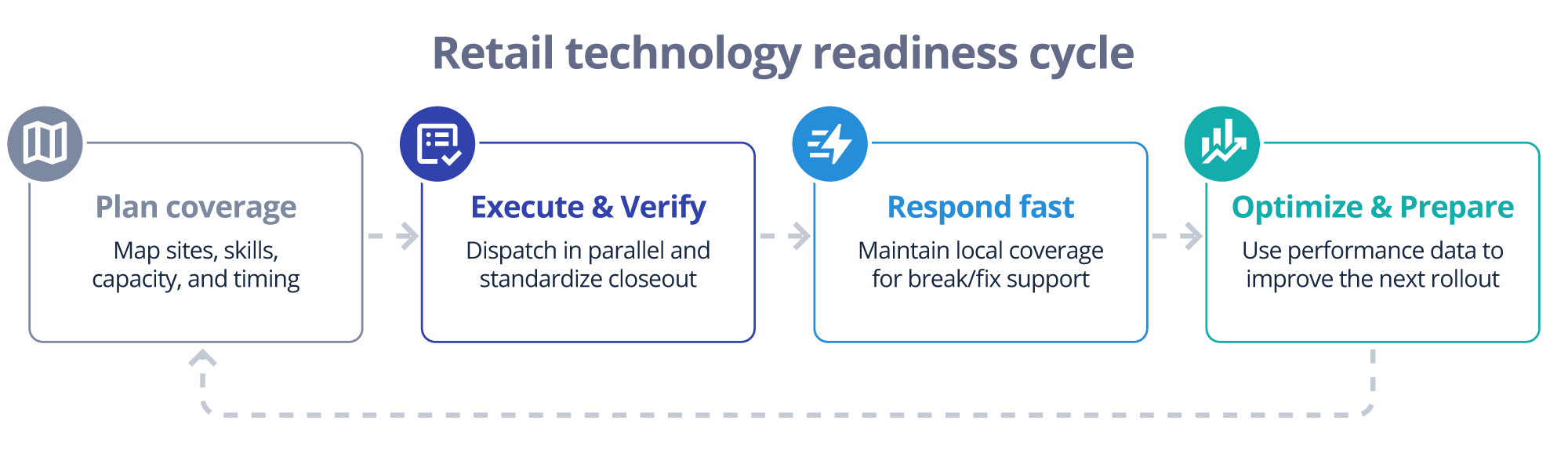
Even when every device arrives staged and ready to install, a rollout can still fall behind. The real bottleneck is matching technicians to the right locations on the right dates, particularly in markets without existing coverage.
Start by comparing technician coverage against every site on the rollout list. The hardest-to-reach markets set the finish date, so finding them early gives you time to close gaps before they delay the rollout.
On-demand labor gives IT service providers technician coverage in every market a rollout touches, without the fixed headcount of employee teams or the margin stacking of third-party vendors. It also lets the company size its labor program to the spike, not the average, without derailing the timeline or budget.
Sending one technician who can handle multiple technologies (such as POS, cabling, and networking) saves both the time and expense of scheduling three specialists to visit the same location.
Maintain technician coverage in local markets throughout the year, not only for the length of one project. That way, you’re not searching for technicians after something’s already broken.
Automated dispatch assigns work based on technician performance history rather than availability alone, so quality holds steady even when volume is high.
Evaluate every job by the same set of performance criteria, so “done” means the same thing at every site. Without that consistency, first-time fix rate can’t be measured, so there’s no way to tell whether a problem is actually solved.
Once the peak selling season ends, service leaders often use the quieter period to run new rollouts. On-demand labor covers the added workload without committing to permanent headcount.
Store closures and consolidations tend to get handled during the off-season, when a quieter store floor means less disruption to active operations. On-demand labor lets service leaders staff for that work as it comes up without the fixed cost of permanent headcount.