
Read time: 5 minutes
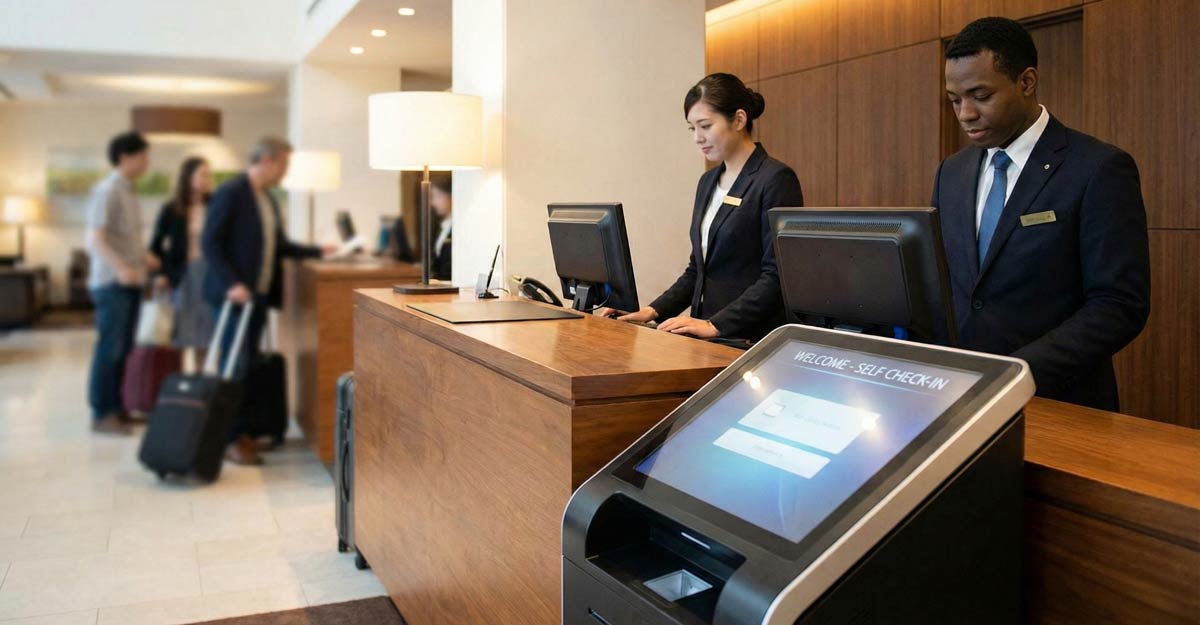

Between new construction, brand conversions, and long-overdue property refreshes, U.S. hotels are generating more technology work than the industry has seen in years. Staffing shortages are pushing properties toward self-service and automation, and rising guest expectations are driving investment in smart rooms, kiosks, robotics, and digital signage.
For field service organizations, that investment is creating opportunity.
The U.S. hotel construction pipeline closed 2025 with 6,146 projects totaling 720,089 rooms. An estimated 708 new hotels are expected to open in 2026, with growth accelerating to 824 hotels in 2027.
But new construction is only part of the story. Brand conversions — which typically require property-wide renovations and technology upgrades to align with a new hotel brand — hit a record in 2025: 1,497 projects representing nearly 149,000 rooms, up 12% year over year. In the U.S. alone, roughly 320,000 to 350,000 rooms are being renovated or converted annually.
Whether a hotel is being built, rebranded, or refreshed, the work almost always involves technology upgrades: networking, cabling, kiosks, AV, security, and more.
Where is the activity concentrated? Extended stay is the fastest-growing segment, accounting for 40% of all pipeline projects. Upper midscale and upscale hotels make up 59% of the pipeline, and these segments have the most standardized technology stacks and the most predictable field service needs. The hottest markets for 2026 openings include Phoenix, New York, Dallas, and Austin.
Staffing shortages are a major driver. According to the American Hotel and Lodging Association, 65% of U.S. hotels still report staffing shortages, and 71% have open positions they can’t fill. Hotel employment remains nearly 10% below pre-pandemic levels, with housekeeping and front desk roles the hardest to fill.
Hotels can’t staff the front desk, so they install kiosks. They can’t hire enough housekeepers, so they pilot cleaning robots. The pattern repeats across departments, and the result is accelerating technology investment that requires skilled technicians to deploy and maintain.
Self-service kiosks and contactless check-in
According to a survey of 2,000 U.S. travelers, 70% prefer checking in via app or kiosk rather than at the front desk. Among Gen Z travelers, that number jumps to 82%. More than 63% of properties have already implemented some form of digital check-in, mobile keys, or smart kiosks.
Smart rooms and IoT
Guests increasingly expect to control lighting, climate, and entertainment from their phones, the same way they do at home. Hotels are responding with connected thermostats, occupancy sensors, smart locks, and in-room entertainment systems. For field service, smart room deployments mean device installations, sensor deployments, and the cabling and networking infrastructure to support them.
Robotics
Hotel delivery robots are moving from novelty to operational reality. Major hotel chains are testing delivery and cleaning robots at select properties. The hospitality robotics market reached $610 million in 2025 and is projected to grow to $1.84 billion by 2030. For field service organizations, robot commissioning, maintenance, and fleet management represent a new and growing work category.
Digital signage and AV
Hotels are investing in guest wayfinding displays, lobby signage, conference room AV systems, and in-room entertainment upgrades. A growing trend is the “room in a box” video conferencing solution, a compact, pre-configured AV package that can be installed by a small crew in under four hours. For hotels with meeting and event space, AV upgrades are a recurring need.
Networking and wireless infrastructure
Every new connected device puts more demand on the network. Hotels are upgrading WiFi systems, separating guest networks from operational networks, and in some cases deploying private 5G for back-of-house operations. Industry best practice calls for replacing wireless infrastructure every three years, and many properties are finding that aging cabling from the early 2000s can’t support the load of modern connected devices, IP cameras, and high-density WiFi. That means cabling audits and rewiring are part of the upgrade cycle, too.
The technology investment in hospitality is showing up in the fastest-growing field service work categories. On the Field Nation marketplace, these work types are rapidly expanding:
Technicians working in retail and quick-serve restaurants will find familiar projects in hospitality. Networking, cabling, kiosks, security, and AV are all core skill sets that apply across these verticals. Hotels share a similar profile: high unit counts, standardized technology across chains, and recurring upgrade cycles. And with the renovation and conversion pipeline at record levels, existing properties need technology refreshes just as much as new builds do.
Hotels are spending to compete for guests and offset labor challenges, and that spending is creating field service work in 2026. With a record renovation and conversion pipeline and an expanding technology stack, hospitality is one of the most promising verticals for field service.
For a complete look at the technologies, verticals, and workforce strategies shaping field service in 2026, explore our Definitive Guide to Field Service Trends.